
Vitamin C…. doesn’t it kind of sound like someone just decided to take their grandmother’s advice for the common cold and extrapolate that to anti-aging skin care? Or maybe it was just an ingredient laying around that was easy to incorporate into more items?
Actually, it really does work.
So, what does it do?
First, go back to my how anti-oxidants work in skin care post to review oxygen free radicals and how anti-oxidants scavenge up those extra electrons. Remember that while those free radicals may have been taken care of, the damage that they’ve already done is still there.
So, Vitamin C, aka ascorbic acid, is one of those anti-oxidants that go around mopping up free radicals. But it also does so much more!
Read on to learn about all the different things that Vitamin C does, a little more about how it does them (I promised I’ve translated as much as possible into “regular” language, though this post is definitely of a higher level than most), and what to look for in a Vitamin C preparation.
Vitamin C as Anti-Oxidant
aka…. Problem: Vitamin C is Easily Inactivated
Yup, unfortunately this is true. It has to do with the chemical structure of the ring and things that can happen to it. Some of this chemistry is a little beyond me (I haven’t taken a real chem class since I was a pre-med, though I did take a lot of them at that time!), so I’ll ask my chemical engineering prof hubby if this is correct.
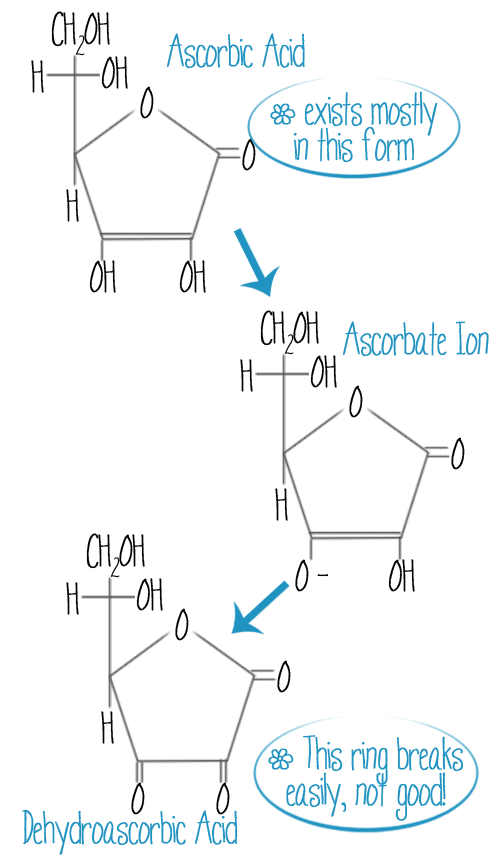
As I understand it, most of the Vitamin C in our bodies is in the Ascorbic Acid form (top right). If it accepts an electron (as part of being an anti-oxidant) it becomes the Ascorbate Ion. What’s interesting about this ion is that while it is “transient”, it is more stable than many other transient ions. It can do one of two things… either donate that electron somewhere else, or pick up a second electron (aka- be an anti-oxidant again!). So, really it doesn’t stick around long as the Ascorbate Ion, it either goes back to Ascorbic Acid or it goes on to become Dehydroascorbic Acid (DHAA).
Now, here is where there is a problem. While DHAA could give off one, or even both of those electrons to go back to Ascorbate Ion or Ascorbic Acid, sometimes that doesn’t happen. Sometimes that pentagon ring there opens instead. Once that ring opens, there is no going back. The whole thing is stuck and the Vitamin C is now inactivated.
Unfortunately, this can happen very quickly. Expose that Vitamin C to a high free radical situation, such as direct sunlight or air and the molecule can quickly progress back and forth between the 3 forms until that ring opens up and it is inactivated. So, Vitamin C quickly accepts those electrons, which can make it a potent anti-oxidant. But, that can lead to quick inactivation.
Cool Thing About Vitamin C: It Helps Collagen and Elastin Creation
Ascorbate is needed in the creation of collagen. Without it, there is no collagen production, or if any is made at all it is structurally not sound since it can’t form properly. This is why Vitamin C deficiency results in Scurvy (oh yeah, remember that?). It also helps with elastin production, though the mechanism isn’t quite clear.
Why do you care about collagen and elastin? If you head back to my dermis post you’ll read about how important they are in the skin’s structural integrity and elastic capabilities. They are key for anti-aging!
What does Vitamin C do to collagen and elastin? There is some evidence that fibroblast cells, in a petri dish, will increase their collagen production is response to extra ascorbic acid. However, it might be a bit of a balance since cell cultures with elevated ascorbic acid levels have less elastin. I know, it is all very confusing, especially since these findings seem to contradict each other. Remember that these studies are done in Petri dishes, which aren’t exactly the same environment as your skin.
So, What Happens to skin when you apply Vitamin C?
1) Aging
There have been studies finding improvement in wrinkles with application of Vitamin C over several months. These studies are not ideal as they aren’t our “gold standard” of a randomized, double blinded trial, but they are positive results.
It isn’t entirely clear how Vitamin C had this effect on wrinkles. Subjects in these studies tend to experience irritation from the Vitamin C application. Is the improvement in wrinkles due to increased collagen, or did the irritation and inflammation itself do something?
2) Hyperpigmentation
Vitamin C is frequently overlooked as an ingredient to help fight hyperpigmentation. It will inhibit the enzyme tyrosinase, so it helps prevent melanin production. There have been studies that found significant lightening of hyperpigmentation with vitamin C. What is really cool about Vitamin C as a pigmentation fighter though, is that one researcher found that Vitamin C didn’t lighten the skin of normal people. Which means that it seems to target the problem pigmentation areas, but leaves everything else alone.
So, use Vitamin C without worrying that it will lighten your skin. Or use it to target those areas of hyperpigemention, but don’t worry that it will lighten everything around the problem area, making it stick out even more.
3) Anti-Inflammatory
Vitamin C has been found to work as an anti-inflammatory. Cells in culture have been found to have decreased levels of inflammatory markers. This has lead some to theorize that Vitamin C can help post-inflammatory hyperpigmentation.
So, How Should You Use Vitamin C?
The interesting thing to know is that oral supplementation of Vitamin C does not seem to affect levels in the skin beyond normal. Meaning, you can drink all the OJ you want, just because there is more Vitamin C in your system doesn’t mean that your body will transport it to your skin or that your skin will even work to take up more of the available Vitamin C from the blood. So, you’ll need to supplement topically.
Vitamin C can be formulated many different ways for skin application. The bad news is that many of these forms aren’t able to penetrate beyond the most superficial layers of the skin, which makes them essentially useless. While there are some manufacturers that claim to have altered formulations to target specific areas of the skin, no one has actually compared absorption rates and depths in human subjects.
What to Look for in a Vitamin C Product
As well, remember all of those instability issues above? You spent the money on that Vitamin C, make sure it doesn’t become inactivated before it even leaves the package!
You should look for Vitamin C products that come in airtight and UV Protected packages. Other strategies have been employed to improve stability, such as encapsulating the Vitamin C, excluding oxygen during the formulation process and using a low pH (in other words, making the formula acidic).
Side Effects
I mentioned it a little above, but you’ll likely have some irritation from Vitamin C use. Usually just a little stinging and mild irritation. My main dermatology text book recommends telling patients to include it in their diet not for the effects on the skin (again, remember you can’t increase the levels in the skin with oral supplementation), but to extend the anti-oxidant benefits to other organs in the body.
My book specifically mentioned the brands Skinceuticals, Murad, La Roche-Posay as the best for effective Vitamin C products.

Check out more anti-aging skincare information and reviews in my guide!
 I’m a doctor, a mommy and a bit of a beauty addict. If you let me, I can take 2 hours to get ready in the morning. Really. I'm on a quest for faster beauty that works!
I love these scientific posts. Cant wait to read more.
Thank you for such an informative article – so helpful to find this when there is so much misinformation around!
Love the technical stuff! I'm a dentist and I've forgotten most of my regular chem classes as well, except for organic chem for some reason.
Great post that put in understandable terms confusing chemistry that's really important. When the vitamin C in a product is inactivated it's caramel colored, that's one way to see if the product still has some active. I've tried lots of vitamin C products over the years in my practice and CRS is the one that I think is tops. The Topix chemists used a dimethicone base and the airtight, light impenetrable container that we want to see. It would be nice to get great studies but they just don't happen without a big pharma budget. Hmmm
Great job breaking down the information! I love learning about how anti-oixidants work to help the skin.
Great post! I used to use Skinceutials C&E Ferulic serum but it just got too expensive. That was also before I became a beauty blogger and had to try eleventy billion different skin care brands. I think I will try to find a cheaper Vitamin C serum and incorporate it back into my routine.
Great post. For someone like me who knows nothing I'm thrilled to have an expert opinion.
Thanks for the great comments everyone! I worked on this post for MANY hours. 😀
Cindy, I've used that same serum and really liked it, though I agree that it is expensive! I need to write it up still, I had been waiting on this post to be complete before I did. Hopefully in the next month or so.
Great post Christine!! I have been reading and hearing so much about Vitamin C lately…The Kiehl's New Year's live chat that just happened kept bringing it up. I just looked up some of the brands you recommended and most of the Murad Essential C products, such as the Active Radiance Serum which claims to have a Vitamin C complex, don't have Absorbic Acid listed as their ingredients, but they have Absorcate or Orange Oil..are these just as good? Sorry I am still confused about the chemistry and what ingredients to look for!!
Essential-C Daily Renewal Complex® has Absorbic acid listed in the ingredients and it is their most expensive products of the Essential C so I am thinking maybe that is the most authentic?
The orange oil shouldn't be as good (think of it like you would Orange Juice, there's Vitamin C in there but it's just one component), but the Absorcate is probably the vitamin C.
I wouldn't worry as much about which form of Vitamin C (other than orange oil, I probably wouldn't count that as Vitamin C), I'd look for anything that says Ascorb… or Vitamin C and pretty much count that.
The Essential C Daily Renewal has it as the #2 ingredient, the Active Radiance Serum has Sodium Ascorbyl Phosphate, which is also Vitamin C (it's about 25% down), the Essential-C Day Moisture SPF 30 has Tetrahexyldecyl Ascorbate…
They all seem to have Vitamin C, though when you look the Ascorb bit is just buried in there a little. Quite a few of those forms, like that Tetrahexyldecyl Ascorbate have been chemically altered to be more easily absorbed and more stable, which is great!
So I've started using vitamin C, but I've heard that not only is unstable or oxidized vitamin C useless, but that oxidized vitamin C can actually have the opposite effect on skin health if used because of radical formation. What do you think of this? And, do the benefits of using Vitamic C serum outweigh costs of possibly using a bad batch? is there a good way to test vitamin C presence at home? maybe with a litmus strip or a simple titration?
Hi Shruti,
Because the vitamin C will have that ring break pretty quickly once it becomes fully oxidized, its chemical structure is changed enough that it can't give off any radicals/assist in radical formation. Theoretically, it could do this prior to the ring breaking, but it goes back and forth readily and then the ring breaks, effectively trapping those free radicals in the vitamin C that's now broken. So, I wouldn't worry about radical formation, there's a reason so many derms love Vitamin C 😀
I don't know of a way to check for activity at home. Dr. Bailey does say in her comment above that "When the vitamin C in a product is inactivated it's caramel colored, that's one way to see if the product still has some active" So, that seems like a pretty easy way to me!
Great post! Thanks(:
Rawrs, Evey
bellaevey.blogspot.com
I would love to hear your take on post-call skincare!
Thanks for the article dear. It was so helpful.
This is a very long post that really says you just don't know. So just say that!
I'm pretty sure it didn't say that at all….
Are you mental? I am a professional with a science background and I can tell you that the talk about free radicals and electrons is pure gibberish. I don't care what terminology you use to promote beauty products, but please don't misuse actual science terms!
Umm… I guess anyone feels free to be rude in the internet, huh?
I'm board certified in 2 specialities, and I'm married to a chemical engineer. While I've simplified things and converted over to lay terms to explain scientific ideas (something any physician should be able to do when talking to their patient), and I've tried to make things entertaining, I find it interesting that you think free radicals are pure gibberish.
In fact, free radicals (and reactive oxygen species) were first proposed in the 1950s and are a VERY widely accepted theory for aging of the skin, something I've made up for fun.
Thanks.
Do you know about any vitamin c product you can buy at a health food store or pharmacy that can be used on my skin? I have hyperpigmentation all over my face. And thank you for your post, very informative!
Not that I know of from a health food store. I'd look at products like the Kiehl's Clearly Corrective.
Hi… I love your article even though I can only understand some of it..LOL.. Right now I am using Vitamin C powder
( L- ascorbic acid). I make a small amount everyday just before using it and use it with Hyaluronic acid powder also .
I have a few scar that have some pigmentation so I am hoping it helps. So far they look a bit better ! To make it absorb a bit better I have been using a derma roller with short needles and go over my fave only lightly a few times. It gets red but disappears after an hour so I do this at night. I have seen results and honestly I think my skin is looking a bit more even skin toned and smooth. I use alot less makeup now and love that ! I am going to do this always as skin care ! Love it !
i recently read an article on making your own vitamin c serum. I think it contained absorbic acid distilled water and vegetable glycerine. What would be your advice about this.
I love the idea of making your own serums like that, but I just don't know how stable the vitamin C would be in such a formulation. There are a lot of tricks that the skin care companies have to keep it stable (and therefore active) for a long time.
I am a huge fan of murad and was so funny to come across this, whilst looking at why vitamin c is good for the skin. Murad daily renewal complex contains a patented formula so that is why you may not see all ingredients as they are top secret! But what I do kbiw is the vitamin c is the purest form you can get an is encapsulated so can be in a tub safely without becoming inactive, the vitamin c is water and oil soluble Is purest and this product does what it says on the tin, pigmentation is reduced massively, this combined with the radiance serum really is the best I have ever used!
Thank you for your post. Two follow up questions, please:
1) Are there any actives with which C is not compatible?
2) I understand about homemade serum not remaining stable for long. What is your opinion about just adding a bit of Vitamin C powder to an oil or water base daily in an effort to make sure you are using a fresh and stable product?
1) I think that depends on the exact formulation of the vitamin C and the other stabilizers in the formulations. There are some forums online that say things like “This ingredient is always unstable with this…” but usually in actual testing those claims aren’t true as they don’t take into account differences in chemical formulations and the stabilizers that are present. The technology has advanced to the point that as long as you’re using a good brand you’re probably fine!
2) The powders and oils and such that are formulated just for adding to products (there’s a great one by Philosophy) are formulated just for that purpose and are stable. I think they’re great!
Love the technical stuff! Keep it comin’ (time permitting of course)! Truly we appreciate your work on this. C is a tricky one, at least for me. SkinCeuticals is my failsafe, but is often prohibitively expensive given my skincare budget. I’m always on the lookout for a super effective product at a reasonable price point, but there is always the worry about stability/formulation. Have had some weird experiences with Vit C over the years. I’ve had CE Ferulic oxidize, while my Topix micellar pads have both l-ascorbic acid and ascorbic acid and haven’t changed color a bit in their tub (didn’t buy them solely for these two ingredients obvs). And what’s the deal with the CE Ferulic patent/pH thing? Maybe is a rumor.
My current solution to the antioxidant dilemma is to have a little alpha-l-ascorbic acid from a derm based brand around for when I want the best protection, then use other stuff on most days. Liked the philosophy before, but right now my “powder” product is The Ordinary 23% water free suspension. I’ve also embraced tetrahexadecyl ascorbate as is less sensitizing: I use SkinMedica dermal repair as The Ordinary formulation doesn’t work with silicones. Dermal repair, even tho the Vit C is a stable form, will oxidize due to packaging so you need to use efficiently. Finally, I use Topix green tea serum/cream as it’s a decent antioxidant and is super calming and soothing and helps manage other aggressive skincare products- Vit A, acids, hydroquinone. Whew! All this effort makes one want to pay a derm to manage and recommend all this stuff for you.
Yes, that’s definitely why dermatology is a long residency! And it is all changing all the time. I’ve heard good things about the product from The Ordinary that you mention, but haven’t tried it myself.
Both TO 23% silicone free and the 30% in silicone layer well with Lytera followed by water based moisturizer and sunscreen. My face turns red temporarily and stings slightly, but this goes away by the time I’ve applied my remaining skincare. I think they are great low cost vit C products. I don’t like most of Deciem’s liquid vit C products, with the exception of the ethylated ascorbic acid (haven’t tried yet).
Hey Christine, I just found your blog and love it!!! I believe you are right about the ring. I have taken a couple chemistry classes and I think you would consider that an epoxide so there is stress on that point in the ring. So that explains why it wants to be “unstressed” and become “chill” and unfortunately by becoming relaxed, it falls apart. Even molecules have their days…
Yes, you’re right, I just didn’t want to get into all of that in a blog post 🙂
Thank you so much for your informative post. I’ve been scouring the internet and just love your page! I am wondering specifically about vitamin C applied topically in pregnancy and safety. Is if safe during pregnancy? Do different derivatives or concentrations matter? I apologize if you have covered this elsewhere on your website. If so please direct me to the right area. Thank you!
Vitamin C in pregnancy is fine. I have a post here: Pregnancy safe Vitamin C products
Hi Christine! Any fave pregnancy safe Vitamin c’s you can suggest? I am used to medical grade. Thank you, m
Here you go! Double check safety on the individual brand pages though, I update those way more than the round ups. Pregnancy Safe Vitamin C Skincare